5 Best Ways to Get 3D Printing Designs You Can Actually Sell
Want to sell 3D prints without breaking a license? Here are the five best ways to get sellable designs in 2026, from free CC0 files and Thangs memberships to Hive catalogs and designing your own with AI.
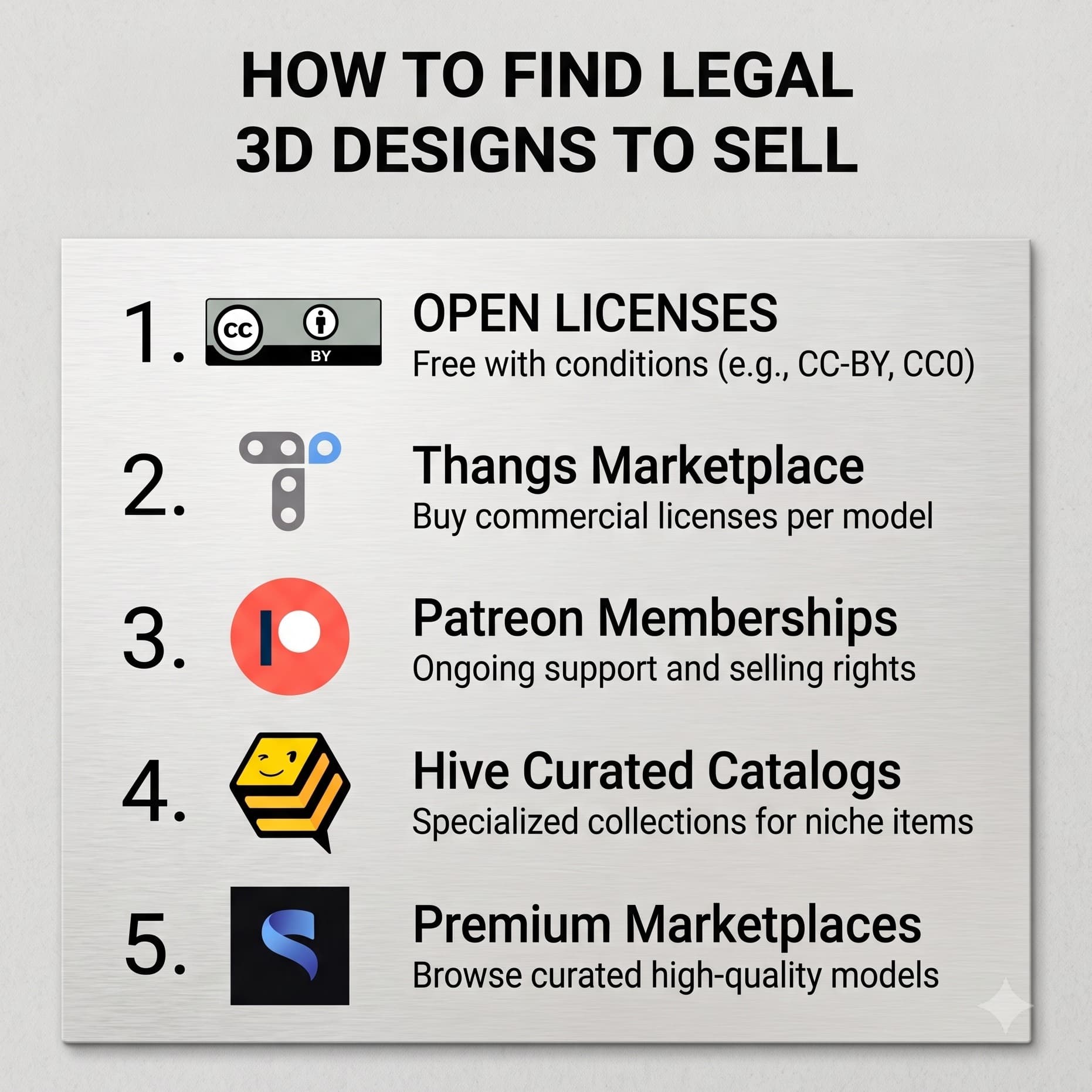
To sell 3D prints you need two separate things: a design, and the legal right to sell what comes off the printer. Most new sellers only get the first one. Downloading a free STL is not permission to sell it, and paying for a file is not the same as buying a license.
Here are the five best ways to get designs you can genuinely sell, in the order most print businesses run into them.
First, the rule that decides everything
The license lives with the creator, not with the platform. Printables, Thingiverse and MakerWorld are full of models that are free to download and still illegal to sell. A few terms to recognise before you spend money:
CC0 / Public Domain — do what you want, including sell prints. No credit required.
CC-BY — you can sell prints if you credit the designer.
CC-NC (Non-Commercial) — no selling. Ever. Even if you printed it yourself on your own machine.
Commercial license — written permission to sell physical prints. This almost never includes the right to resell or re-upload the file.
If the terms don't say you may sell physical prints, assume you may not. Save a screenshot of the terms you agreed to, with the date on it.
1. Designer memberships on Thangs, Patreon and Tribes
Cost: typically $5 to $20 per month, per designer
This is where most sellers start. You subscribe to an individual designer on Thangs, Patreon or MyMiniFactory Tribes, and the tier includes commercial rights to sell physical prints. You usually get early access, monthly releases and a direct line to the designer, who will often hand you photos and assembly guides.
Three things to watch:
The Thangs Bundle subscription is not a commercial license. It gives you downloads across many creators, but selling rights come from a specific designer's membership.
On most memberships your permission lasts only while you're subscribed. Cancel, and your right to sell those prints can end with the payment.
Some designers sell perpetual per-model licenses instead, on Cults3D, MyMiniFactory or through MakerWorld's Commercial License Memberships. Worth it when you have one proven bestseller and don't want a recurring fee.
The catalog is open to everyone who subscribes, so back a popular designer and you're in a crowded market again, just a more polished one.
Best for: building a shop around one consistent visual style.
Go to Thangs : https://thangs.com/
2. Hive by Cubee
Cost: entry plans up to multi-catalog subscriptions
Hive works differently from a designer membership because it was built for the seller rather than the fan. HiveCommunity is the entry point: over 1,500 royalty-free designs with full commercial selling rights and no royalties on what you sell. Hive Plus adds one exclusive designer catalog capped at 50 sellers worldwide, with a 10% royalty handled through the CubeeTrust system. HivePro bundles five or ten catalogs together with business coaching.
The seat cap is the point. Instead of competing with several thousand people printing the same dragon, you're one of fifty licensed sellers on that catalog globally. That's what lets you hold a premium price.
Every design comes with a media library of photos, videos and written copy, which is the part most sellers badly underestimate. Shooting decent product photography for twenty SKUs costs more time than printing them. You can sell the printed items anywhere you like, on Etsy, Amazon, Shopify or at markets, under your own brand or the designer's. What you can't do is sell or share the files.
Best for: sellers who want lower competition and marketing assets that are ready to publish.
Get HIve: https://www.cubee3d.com/
3. STLFlix
Cost: personal and commercial subscription tiers, monthly or annual
STLFlix is closer to a Netflix model for STL files: one subscription, a large multi-theme library, and roughly twenty new models a week. The catalog runs into the thousands and is organised by category, with functional pieces, decor, articulated creatures, cosplay props and seasonal items.
The critical detail is the tier. STLFlix sells both personal and commercial plans, and only commercial subscribers are allowed to sell printed models. Pick the wrong tier and you have a library you can't legally monetise.
The commercial plan also includes professional photos and videos with full usage rights, a Discord community, and MyStore, an e-commerce layer tied to your library. The catalog is unlimited by seller count, so expect to see the same models in other shops. As with any subscription license, your selling rights depend on the subscription staying active.
Best for: volume and variety, especially if you want a store front and sales material bundled in.
Get HIve: https://stlflix.com/
4. Free models with open licenses
Cost: $0
Filter by license on Printables, Thingiverse or MakerWorld and you'll find thousands of CC0 and CC-BY models. Scan the World and the Smithsonian Open Access archive are also worth a look for busts, artefacts and decor pieces.
This is the fastest way to test a market. Print three products, list them, see what sells locally before you commit a cent to licensing.
The problem is obvious the moment you search Etsy: everyone else has the same files. Popular free models end up on hundreds of listings, and the only lever left is price. Not a business you want to be in for long.
Best for: validating demand and learning your print times before you subscribe to anything.
5. Design your own with KishMake
Cost: from $1 per model
Every option above has the same structural weakness: someone else owns the design, and other people are printing it. Making your own removes both problems at once.
KishMake is an AI 3D model generator built for print shops and makers. Describe what you want in plain English, or start from an image, refine it with follow-up prompts, and download a print-ready STL or 3MF. It takes about three minutes and needs no CAD experience. You keep the rights to the models you generate, and you're free to use them commercially.
Commercially that changes the shape of the business:
No royalties, no seat limits, no license that expires when a subscription lapses.
Nobody else has your listing, so you're not competing on price.
You can sell the file as well as the print, on Cults3D, MakerWorld or Thangs.
You can offer custom design as a service. Personalised name plates, pet keychains, corporate gifts and D&D minis carry far better margins than generic prints, and turnaround measured in minutes is what makes that offer possible.
One responsibility stays with you: AI can produce infringing output, so don't prompt for characters or logos you don't own. Original designs only.
Best for: anyone who wants a product line nobody can copy from a public catalog.
create with kishmake: kishmake.com
Which one should you choose?
If you're starting from zero, test the market with free open-license models first so you learn what your customers actually buy. If you want one coherent style and a designer you can talk to, take a membership. If your problem is too much competition, a capped catalog like Hive protects your pricing. If your problem is not enough products, a broad library like STLFlix fills the shelf fast. And if you want something nobody can copy, design it yourself.
Most sellers who make real money run two of these at once: a licensed catalog for reliable volume, and their own designs for the products they actually want to be known for.
How to check any license in 60 seconds
Open the model page and find the license text, not the platform's marketing page.
Look for the phrase "sell physical prints" or equivalent. Vague wording is a no.
Check whether the rights end when the subscription ends.
Check whether attribution or a seller ID is required on your listings.
Screenshot the terms with the date and keep them in a folder per source.
FAQ
Can I sell 3D prints made from free STL files?
Only if the license allows it. CC0 and CC-BY models can be sold, with credit required for CC-BY. Anything marked non-commercial cannot be sold, even if you paid for the filament and printed it yourself.
Does buying an STL give me the right to sell prints of it?
No. Buying a file usually buys personal use. Selling physical prints requires a commercial license, which is a separate permission from the designer.
Do I need a separate commercial license for every model?
It depends on the source. Individual marketplaces license one design at a time. Subscriptions like Hive and STLFlix cover an entire catalog under one agreement, and a designer membership covers that designer's models. Models you create yourself need no license at all.
What happens to my listings if I cancel a subscription?
On most memberships and catalog subscriptions your selling rights end when payment stops, which can force you to pull live listings. Read the terms before you build a shop on them, and prefer plans that state clearly what happens after cancellation.
Is it legal to sell 3D models made with AI?
Yes, as long as the output doesn't copy someone else's protected character, brand or design. With KishMake you retain the rights to the models you generate and can use them commercially, and the responsibility for keeping the output original sits with you.
Which method is the most profitable?
Designing your own. There are no royalties, no seat caps and no price race against other sellers using the same file. Licensed catalogs get you to market faster, so many shops use both.
Related reading
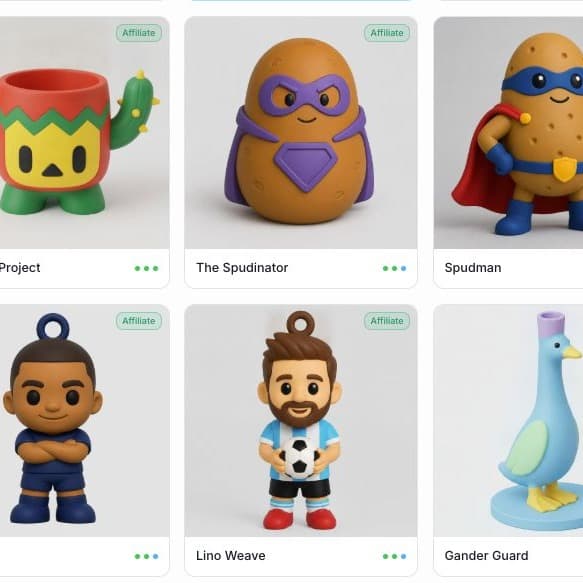
Run a 3D-print store? Embed KishMake into your site.
Join the API waitlist for early access to design-on-demand for your customers.
